
White County Criminal Docket Searches
No free search covers every White County criminal docket at once. Begin with whatever court is named on the citation, warrant, bond paper, or mailed notice. The Superior Criminal Division handles felony and other Superior-level matters locally. For first appearances, arraignments, committals, and bond modifications, the Magistrate calendar hub posts dated lists. PeachCourt serves covered Superior electronic records, though its search route requires an account.
Before calling, pull together the case, warrant, or citation number. Have the accused person's full name, the offense, the arrest or filing date, and the expected court close at hand. White County publishes no universal criminal case-number pattern. So never convert a calendar code into a guessed case number. When an online result is missing, a direct clerk request is often the clearest route.
- Read the paperwork and identify the named court.
- Check the matching White County calendar category and date.
- Call the Clerk at 706-865-2613 or Magistrate Office at 706-865-6636 with the identifying number.
- Ask whether inspection, an ordinary copy, or a certified copy fits the need.
- Confirm that a listed setting occurred and was not continued.
White County Criminal Accusation Routes
A Superior criminal matter in White County can be charged more than one way. A case may start with an arrest on a warrant or citation. It can then proceed through a district attorney accusation, a grand-jury indictment, or a special presentment. The accusation is a formal charge filed by the prosecutor. An indictment is the grand jury's own charging instrument. A special presentment also comes through that grand-jury process. The docket entry tells you which route was used.
The Clerk files and keeps pleadings from the State, defendants, and counsel. Wondering when a warrant matter gets accused or indicted? The county points callers to the District Attorney at 706-865-3306. That office answers prosecution-timing questions, while the Clerk stays the record keeper. Neither office can give legal advice or discuss a pending case outside the permitted process.
The official Superior Criminal Division page lays out this local routing in context:
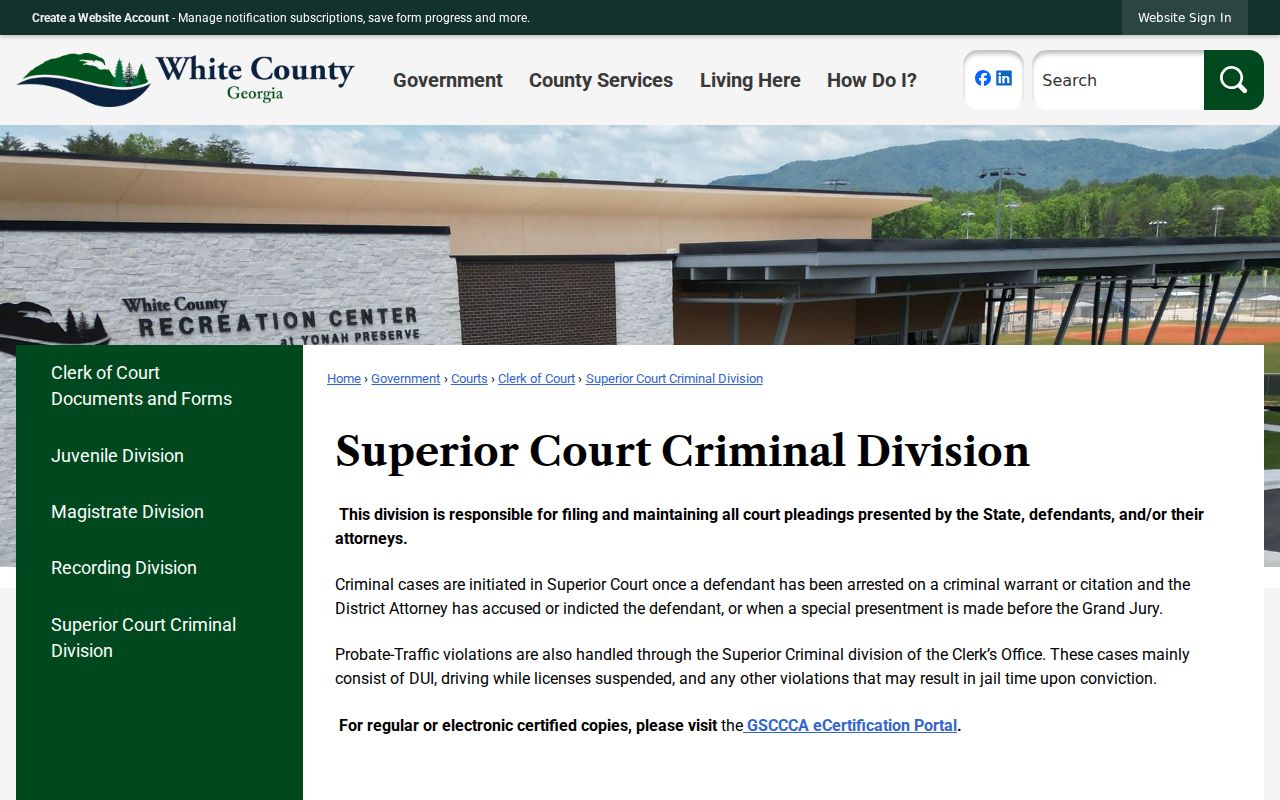
Its division-specific instructions help separate a maintained court record from an arrest list or a general county records request. That distinction matters when you ask the clerk for a copy of a criminal docket.
Criminal Dockets: What They Show
Think of the White County criminal docket as a timeline. The calendar is a schedule. One records events in order as they happen in a case. The other lists what the court will hear on given dates. Docket entries can name the case, the parties and their roles, and the allegations. They may also cover pleadings, hearing settings, orders, and the disposition. The filed paper or electronic image behind each entry is the underlying document. A certified copy carries the keeper's authentication. That carries more weight than any view of a calendar page or a search result.
| Case Number | The court's identifier. White County did not expose one universal public format, so copy it exactly from the record. |
|---|---|
| Charge or Offense | The allegation listed in the case. It is not a finding of guilt. |
| Hearing Setting | A planned first appearance, arraignment, committal, bond hearing, bench trial, or other event. |
| Pleading or Motion | A paper filed by the State, defendant, or attorney. Filing alone does not mean the judge granted it. |
| Disposition | The result or case-ending action. Verify the latest entry and underlying order with the keeper. |
Read from the first filing forward to the newest event. Keep a scheduled hearing apart from a completed one. Keep a motion apart from an order. A bond amount concerns release or security, not a fine and not a conviction. When an entry is unclear, request the document. You can also ask the court to confirm its status.
White County First-Appearance Docket Fields
White County's official first-appearance form works as an operational hearing list for detention-center inmates. Each row records the row number, name, offense, arrest date and time, submitter, and submission date. Citation copies and bond amounts accompany the submission when they apply. Names deserve care. An early appearance records an accusation and a custody-stage event, not a final result.
The schedule around the form shows how it runs. Material goes to the Magistrate Office by 9:00 a.m. Hearings follow at 10:00 a.m. Monday through Thursday and at 3:00 p.m. Friday through the stated remote connection. Those times explain the form's operation only. Confirm the current setting rather than treating an archived PDF as a fresh notice.
- First appearance
- An early hearing after arrest addressing initial procedure and custody issues.
- Committal
- A hearing concerning whether a criminal matter proceeds at that stage.
- Bond modification
- A request or event concerning the terms of release, not the case result.
- Arraignment
- The stage at which charges are addressed and the plea process occurs.
Criminal Case Stages on the Docket
Every White County criminal docket opens with a charging record suited to that court: a warrant, citation, accusation, indictment, or similar filing. First appearance, committal, and bond review often come early. Arraignment follows on the applicable calendar. Motions, notices, and continuances can stack up several entries before a plea or trial. Then judgment, sentence, dismissal, or another final action supplies the disposition information.
Docket flow: Filing › Arraignment › Pretrial › Plea or Trial › Disposition › Sentencing
That sequence is a reading aid. It is not a promise that each case takes every step in order. A continuance moves a setting; it does not dismiss the charge. A calendar entry also cannot prove the hearing occurred. When the sequence matters, check the newest docket event and the related order.
White County Criminal Date Notices
White County mails notice of a Superior criminal court date. That is, unless the bond or citation already shows it. Moved recently? File the county's written Change of Address form. A phone call will not change anything. Along with identity and contact details, the form wants the case, warrant, or citation number. It also wants the court involved, the charge, an uploaded ID, and a typed signature.
When the mail never comes, start with the bond or citation. Then read the right court calendar. Call the record keeper with the identifying number in hand. Silence does not mean a case ended. The criminal division sends questions about Superior accusation or indictment timing to the District Attorney. For a Magistrate event, contact the Magistrate Office and check its published calendar category.
Missed or uncertain date: Contact the named court at once. An archived calendar cannot confirm a reset, continuance, or later order.
White County Criminal Docket Courts
Felonies and other Superior-level criminal cases in White County belong to Superior Court. The Clerk of Court keeps those pleadings. Superior Criminal also takes the county's probate-traffic violations. These include DUI, driving while a license is suspended, and offenses that can mean jail time. So the court printed on a citation beats any guess. Don't rely on the word "traffic" alone.
Magistrate Court issues warrants and covers listed misdemeanor categories, with no jury. Probate plus the Cleveland and Helen municipal courts hold other traffic, misdemeanor, or ordinance matters. It depends on jurisdiction. Juvenile Court is its own route with different access limits. White County has no separately identified State Court, so don't invent one in a search.
| Court | Criminal docket role | Starting point |
|---|---|---|
| Superior | Felony, Superior-level matters, and serious probate-traffic routing | Clerk or covered PeachCourt route |
| Magistrate | Warrants, early hearings, and specified misdemeanors | Calendar archive or Magistrate Office |
| Probate or Municipal | Traffic, misdemeanor, or ordinance work within that court's authority | Citation and named court |
| Juvenile | Juvenile matters under special confidentiality rules | Juvenile Court lawful-access process |
White County Magistrate Criminal Dockets
The White County Magistrate Court handles arrest, inspection, and search warrants. It also covers misdemeanor deposit-account fraud, possession of less than one ounce of marijuana, shoplifting, refund fraud, underage alcohol possession, and criminal trespass. A separate Magistrate Division description words some categories differently or sets different thresholds. Read both official pages together rather than flattening them into one list. The Magistrate Clerk, at 706-865-6636, can confirm the exact charge and jurisdiction.
Labels in the public archive describe docket events. Think arraignment, committal, first appearance, bond modification, and bench trial. They say nothing about the outcome on their own. White County's division pages also keep roles clean. The Clerk maintains records, the prosecutor decides accusations and indictments, and the Public Defender handles appointed-counsel eligibility. Court staff cannot give legal advice. Routing your question to the right office saves delay. It also keeps a calendar clerk from being treated as counsel.
Access Rules for Criminal Dockets
Georgia court records are generally open. The access still has real limits. A seal order, statute, court rule, juvenile confidentiality, or a protected identifier can restrict a White County criminal docket or its documents. A docket may show a filing exists while the paper itself stays offline. When an item is missing, ask the keeper. The item may be sealed, confidential, unindexed, held by another court, or available only through a lawful request.
Key rules:
Uniform Superior Court Rule 21 governs public inspection, sealing procedure, review, and protected filings in Superior Court.
Georgia Attorney General access guidance explains records-law timing, costs, exemptions, and the distinct treatment of court records.
O.C.G.A. § 9-11-7.1 and Rule 21.6 restrict protected identifiers in filed records.
The general White County Open Records form expressly excludes the courts, the District Attorney, and Clerk of Courts records. Send a criminal docket request straight to the court or clerk instead. The county publishes no public terminal listing and no single current court-copy fee schedule.
White County Juvenile Criminal Records
A Juvenile Court matter is not an ordinary public Superior or municipal criminal docket. Georgia law gives juvenile-court records and related law-enforcement records special confidentiality treatment. Getting access can require a Juvenile Court order. And if no record turns up online, that alone is not evidence the proceeding does not exist. For the legal context, the official Georgia Attorney General juvenile-record opinion sets out how the state treats these records.
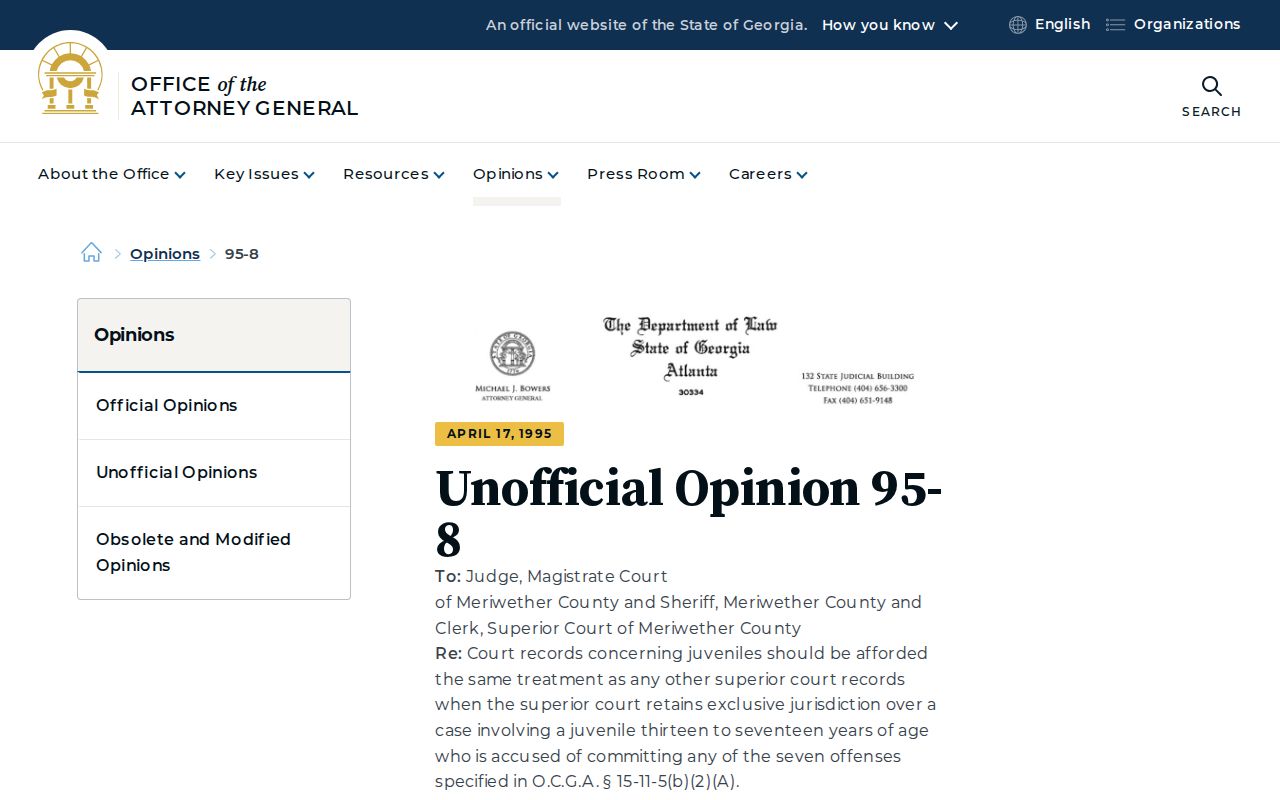
The source shows why juvenile access must run through the Juvenile Court's lawful process rather than the ordinary White County criminal docket search chain. Never publish a child's identity or try to slip past a restriction.